Wednesday, December 29, 2010
Alumni Corner: Joseph Allen
 Name: Joseph A. Allen
When did you graduate?
December 2010
What is your current job role and where?
Assistant Professor, Industrial/Organizational Psychology
Assistant Editor, Journal of Business and Psychology
Department of Psychology
Creighton University
Working with various faculty members and realizing how much they care about the success of the students. They don’t get enough credit for working with the students or for the amount of time and energy they put into the students. Because of their support, I could go to any of them with questions and they were all very helpful.
In reflecting back, what are the top three things you are taking away from the program?
1. Continued collaboration with OS faculty.
2. The teaching experience I was allowed to have while at UNCC and having a faculty mentor to guide me thru that process. Being exposed to that in a more supportive environment helped me be more prepared for my role at Creighton. It helped prepare me for dealing with students and teaching.
3. Making time to help others around you. If someone, at some point, hadn’t taken an interest in me, I would not be where I am today. The faculty and students in the OS program tend to keep an eye out for those who they can help and serve. I’m in essence trying to give back to the institution and process that helped me get here.
What advice do you have for new students on how to succeed in graduate school?
Work, work, work! There is no satisfactory substitute, especially as a grad-student. Thankfully, my wife and daughters were very supportive. I could work long hours and they were always there telling me to keep going and get it done. Also, “Celebrate the victories by climbing the next mountain.” Every time you achieve something don’t just sit there and think about how wonderful you are. Take a little time to enjoy the moment but keep on task. It is a marathon. If you don’t keep on task you will never get it done.
What job search tips do you have for current students?
First, please recognize I can only speak to the academic side of the job search. However, don’t be too picky at first in terms of the jobs you apply for. Although you should be selective to within a particular field (Management, I/O, Org. Comm., or Sociology), you also need to be open to opportunities you might not have considered before. Due to the publication lag, you MUST begin working with a professor during your first semester on publishable projects. It could take up to 3 or 4 years to be published and being published is very important. For example: I applied for 30+ jobs in the summer of 2009 with no publications and a lot of things under review. No one (absolutely, no one) wanted to talk to me at conferences or over the phone. However, in October 2009, I had 5 manuscripts go to “in press”. I then sent another 13 applications with this new information and received several interviews, invites, visits, etc. The only difference in my CV was the publications. Everything else, (e.g. teaching experience, dissertation progress, conference submissions, internships, consulting, etc.) was the same.
What about for preparation for going on the job market?
1. Publish or Perish
2. Gain teaching experience
3. Learn about the job search process in your first year
4. Keep track of everything you do
5. Get your vita started (look at examples of peers)
6. Be optimistic…OS students are seeing some real successes in a bad job market
Read more...


Alumni Corner: Heather Gordon
 Name: Heather Gordon
When did you graduate?
June 2010
What is your current job role and where?
Leadership Development Consultant
Leadership Assessment & Talent Analytics
Enterprise Leadership Development
What are your greatest memories of OS?
It would be the group sessions with all the students and faculty together where we would all share ideas regarding research topics. I heardsuch diverse perspectives on topics I wasn’t very familiar with and began thinking of things in different ways than what I was used to.
In reflecting back, what are the top three things you have taken away from the program?
1. The ability to do both qualitative and quantitative statistics analysis. It is something I do on a daily basis within my current role.
2. The ability to work with people with very different perspectives and learn to be open to very different ideas.
3. The ability to present and communicate both in writing and verbally.
What advice do you have for new students on how to succeed in graduate school?
Be open to new opportunities. Understand the way you think and feel today may not be the case later. Be open to change. Reach out if you are having any issues. There is always someone there to assist or offer you guidance.
What job search tips do you have for current students?
Network! Use your years in the program to attend conferences and network with individuals. Also find local events and chapters for networking. Make sure you get out there and tell people what you do within the program, what you are learning, whatyou can bring to an organization or school and why the OS program sets youapart from other candidates.
What about for preparation for going in the job market?
Do your research on the organizations or schools you are interested in, just like you would for a research paper. Use due diligence from the very beginning. Understand what issues the organization is facing or what sets it apart from others so that you are fully prepared as you go into the interview.
Read more...
Faculty Spotlight: Dr. Eric Heggestad
by Logan Justice
Why did you decide to become a professor?
What advice do you have for graduate students on how to get the most out of graduate school (to succeed in graduate school)?
What do you most like about being part of the OS program?
What is the coolest project that you are currently working on?
Read more...
Monday, December 13, 2010
Faculty Spotlight: Dr. Shawn Long
by Logan Justice and Daniel Bonilla
Read more...
Thursday, September 16, 2010
The OS Program Welcomes The Incoming Class Of 2010
by Logan Justice Name: Lindsay Miller


Read more...
Thursday, January 28, 2010
Organizational Science’s First Exchange Student Completes Year with Program
by Joe Allen Yufeng “Jane” Ma, an exchange student from Renmin University of China, arrived in Charlotte, N.C., on Oct. 29, 2008. She was invited to attend the Organizational Science program for a year to experience doctoral education in the United States. Ma’s main purpose in visiting was to learn about class structure and how American professors train their students.
She sought out opportunities to “Talk with professors and students to see their logic in approaching research questions.” Her motto was to “Not be shy and ask questions.” While attending various classes and activities, Ma had the opportunity to join or initiate several projects with current students at UNC Charlotte.
For example, she had an interest in studying emotional labor across cultural boundaries. This led her to collaborate with Joe Allen. They are currently working on a project looking at how emotional labor is manifested in the United States and China. Ma also connected with April Spivack and David Askay and is working on a project concerning abusive supervision in organizations.
And if that wasn’t enough work, Ma took time to develop a model for her dissertation, work on a few papers from her work at Renmin, publish one paper in a Chinese journal, and have a conference paper accepted to an international research conference in Moscow.
When asked about her experiences at UNC Charlotte, she said “American students are very patient. They always were kind and helped. My American friends are polite and seemingly empathetic to my needs.”
Even as Ma prepared to return to China, she couldn’t help but reflect on all the things she’s going to miss. “I will miss my colleagues the most. We had a good time and shared funny stories.” She also acquired a distinct affinity for American cuisine, saying “I will miss the food: macaroni and cheese, hamburgers, and pizza; and desserts like muffins, cookies, brownies, cakes, etc.”
Regarding her return to China, Ma said, “I want to stay longer to see what happens in the future. I want to be around you guys. I am really thankful to the Organizational Science program. This program is so, so, so nice. I am so, so, so happy when I am here. You guys are very, very, very helpful.”
 Where is she now…
In a letter to the program Jane wrote:
“It took me a while to get used to China. Beijing is very noisy and crowded compared to Charlotte. Even now I am still not used to it, like the bad traffic. I also saw my friends and family after my arrival. Of course, I ate a lot of authentic Chinese food.
“I was working on my dissertation and had my proposal defense on November 30. I am also working on a few projects, finished two Chinese papers … I also presented one paper at the fourth management conference in China. Now I really hope I can finish my dissertation in time. It is also a big task to apply for a job. I am working on it.
“Now I know SIOP [the Society for Industrial and Organizational Psychology] at Atlanta accepted one of my papers, so I am going to apply for the travel grant from my university. I am looking forward to attending SIOP in this coming April and see my dear friends there. I am also looking forward to seeing any of you guys in Beijing and show this capital city to you. Whenever I meet an American, it makes me think of you guys. I really miss you all.”
Read more...
Editor’s Note: New Features, Future Plans
by Ben Baran Judging from the outpouring of positive feedback we’ve received, the Organizational Scientist is a resounding success. But we’re not getting complacent. We’re continuing to brainstorm and find new ways to improve this communication outlet to better serve both the internal Organizational Science community and its external friends and visitors.
For those of you still getting acclimated to this newsletter’s format, I encourage you to read this article for an explanation of its key features. Additionally, we have two new features in this edition.
- In the feature story on Jane Ma, you’ll see that we have included an embedded video. This is a feature that’s available expressly because of the newsletter’s online format, and we hope you enjoy it. We plan to incorporate more multimedia in future posts.
- You’ll notice a box on the right side of the page with the heading “Subscribe via e-mail.” I highly encourage all readers to type their e-mail address into the text field and click “subscribe.” You’ll then receive a confirmation e-mail, and once you activate your subscription, you’ll receive any updates to the Organizational Scientist in your e-mail. Please note that these updates will only occur when new material is posted and should never occur more than once a day (even if we posted 17 new articles every day, which we don’t).
Finally, two plans for the future are worth noting.
- It’s time to assemble a core team of writers for the next academic year. If you’d like to participate or have any questions about what that entails, please e-mail Daniel Bonilla, who will be next year’s editor-in-chief, at organizationalscientist@gmail.com.
- News happens regardless of publishing schedules. We deliberately chose to begin the Organizational Scientist as a periodic online publication, with all fresh content being delivered in large batches—much like a traditional newsletter. Now that we’re up and running with a dedicated editorial team, we are considering more frequent postings that are closer in time to when news occurs. Therefore, you may notice more frequent posts starting later this semester. This is yet another reason why you should strongly consider subscribing to the newsletter via e-mail as described above, as then you’ll know when new content is available.
Please thank the members of the editorial staff—Marisa Adelman, Joe Allen, Ashley Andrew, Daniel Bonilla, and Kate Frear—for their hard work when you have a chance, and I hope you enjoy this issue.
Cheers,
Ben Baran
Editor-in-Chief
Read more...
Research, Classes, and … Dodge Ball? OS Students Relieve Stress, Have Fun
by Kate Frear Oct. 24, 2009: Six Organizational Science (OS) students, who had signed up to represent the OS program in the first annual Graduate Student Dodge Ball Tournament, arrived—ready for battle. The team—consisting of Daniel “Latin Heat” Bonilla, Adrian “Malaysian Persuasion” Goh, David “Uni-Bomber” Askay, April “Black Widow” Spivack, and Greg “Patches” Berka—had anticipated this event for weeks. On the day of the tournament, several team members showed up early to get warmed-up for the big game. “I've been practicing for the last half-hour to 45 minutes, I'm almost too worn out to play already,” said Askay. To represent their team spirit and create a united front, all OS team members wore their honorary Organizational Science “T”-shirt, boasting the OS catchphrase: “Fostering Transdisciplinary Thinking.”
For the first game, the OS team lined up to oppose the Industrial-Organizational Psychology Masters students. “They better watch out for Adrian,” said Askay, “I've watched him warm up, and he's got quite an arm on him.” As soon as the referee blew the whistle the team experienced an unexpected turn of events. Before any balls were thrown, Spivack took a blow to the face from opponent, Richard Louie. “We both ran for the ball, sprinting, then I leaned back but she fell forward,” said Louie, “and her nose hit the side of my head.” Spivack, who was unavailable for comment until after receiving medical attention, did not incur any serious injuries.

Without Spivack the OS team was forced to disband and play on mixed teams with graduate students outside the OS program. “The teams were randomly selected and everyone had fun with it,” said Berka, “most people just played for themselves after that.” When asked about the mixing of teams, Bonilla responded, “It gave me a chance to meet grad students in other programs so it wasn’t so bad.” He added, “I’ve got a lot going on—sometimes I just want throw a big red ball at someone, regardless of their affiliation.”
All team members were optimistic when asked about playing again next year. “Dodge ball, or any intramural event, is a good way to exercise, socialize, and get your mind off school for a bit,” said Berka, “I hope we do more events like this in the future.” Even Spivack said, “Yes! I would definitely play again!”
For the benefit of the non-dodge-ball-savvy OS students and grad students around the world, we would like to poll the readers for other de-stressor tips and ideas. So, please tell us your thoughts. What’s the best way to relieve stress during grad school? (Please post your thoughts below.)
Read more...
Statistics at Work: An Interview with Dr. Scott Mondore
by Marisa Adelman When was the last time you toiled over a complex statistical analysis? Wanted to bang your head against the computer when your factor analysis failed to converge? Nearly cried when the data did not support your theoretical model? Frustrating as such statistical dilemmas may be, particularly to students early in their graduate career, it is comforting to know that the time and effort we spend staring at the computer is not in vain.
 In addition to earning us a place in the scholarly ranks and helping us to get published in prominent journals, knowledge of complex statistical analyses and the ability to apply such knowledge to business problems can also earn us a spot in the hearts and minds of business leaders. As discussed by Dr. Scott Mondore, managing partner of Strategic Management Decisions (SMD), our statistical abilities can become a key differentiator in the competitive organizational consulting marketplace.
Dr. Mondore joined us on Tuesday, Oct. 27 to discuss the ways in which the statistical analyses we learn in the classroom can be translated into meaningful results and action items for today’s business leaders. The consulting solutions offered by SMD, the company that Dr. Mondore co-founded in January 2009, are grounded in statistical analyses designed to identify human capital drivers of key business outcomes. Specifically, Dr. Mondore and his business partner, Dr. Shane Douthitt, use structural equation modeling to identify relationships between employee data (e.g., performance ratings, training effectiveness, absenteeism, turnover) and the business outcomes that matter most to their clients (e.g., retention, reduced theft).

Based on the information gained through such analyses, Dr. Mondore and Dr. Douhitt are able to help organizations better prioritize their HR initiatives and invest in areas that will yield the greatest impact. I had the pleasure of interviewing Dr. Mondore following his presentation to dig a little deeper into his experiences as an I/O psychologist and as a new business owner.
M.A.: How did you first become interested in I/O psychology?
S.M.: My goal when I first started my undergraduate degree was to get my MBA because I knew I was going to start my own business at some point. At the same time, I was interested in psychology as a field. A good friend of mine introduced me to someone who was in the I/O program. I didn’t even know the field existed and probably speaks volumes about my early lack of focus on studying. I realized that I could get the best of both worlds—business and psychology.
M.A.: What challenges have you encountered in starting Strategic Management Decisions (SMD)?
S.M.: The first big challenge is marketing….constantly. We (Shane Douthitt and I) started SMD in January of 2009, so you have to keep in mind that to all of our potential customers—we didn’t exist the month before. So getting your name out there through as many channels as possible is critical. The marketing can’t stop just because you land a big project—you cannot let your sales pipeline dry up or you will be very bored and poor when that big project is finished. The second challenge is just starting the business. They don’t teach you all of things that are involved in starting a business in graduate school—picking a company name, picking a legal status (LLC, S-corp, C-corp), creating a logo, buying necessary materials etc. You have to do all of this quickly and with little formal training.
 The third challenge is getting everything done—you either do it yourself or it doesn’t get done. We don’t have departments or functions. We get an idea, we talk about it, then one or both of us has to execute it—no exceptions. So, in the midst of constant marketing, sales, account management and delivering on projects, there leaves little time to waste, and no weekends and limited sleep. Finally, if you are used to a steady paycheck every month…then starting a company may not be for you.
Especially early on in the process, you will see fluctuations in your take-home pay. An ability to adapt to change and a tolerance for ambiguity are critical to making it through the early stages of a new business. Having said all of this, I wish I would have started SMD a few years ago. It is a great feeling to be your own boss and take complete responsibility for your own successes and occasional failures. In spite of the challenges, it is a lot of fun and worth the effort.
M.A.: What do you perceive to be the key challenges facing business leaders today?
S.M.: Coming out of this economy, leaders are going to be very careful about hiring—they are going to be very tight with money and not looking to add back all of the staff that they laid off during the recession. The challenge will be trying to keep productivity levels high (i.e. keep staffing levels low) and not work high-performers to death so that they leave the organization. Turnover, in general, will likely spike as the economy turns, especially in companies that were ‘abusive’ to employees during the downturn.
Leaders also have the challenge of improving their hiring processes—with so many people looking for work, they can be more selective, but they need to so without discriminating. People who haven’t worked in a while and don’t have a lot of interviews lined up tend to be a bit more litigious than they normally might be. Merely conducting unstructured interviews will need to be done away with. Business leaders will continue to demand value from all functions—especially HR. Traditional HR processes are not difficult to outsource, so HR leaders need to step up and be better business partners and use measurement to show their value to the organization. If not, their jobs will be in jeopardy or at least their status within the organization will suffer. The silver lining is that I/O psychologists can help organizations with all of these challenges.
M.A.: So how can I/O Psychologists/Organizational Scientists best help business leaders to address their most pressing challenges?
S.M.: Organizational scientists can attack the challenges mentioned above very easily. We know how to build effective and legal selection systems, we know how to create high-potential development programs and career pathing strategies, we understand how to use statistical analysis to connect people data to business outcomes. These three skills are just a few of the things that we can do to tackle these challenges—amongst many other challenges that organizations face every day.
M.A.: Finally, what advice do you have for Ph.D. students in Org Science?
S.M.: The best advice I can give is first to take business classes with your electives, if you can, to round out your graduate degree. If you really want to be a great business partner, it will help to understand how businesses make money and how to read financial reports. That isn’t enough, though. You need to then be able to apply what you do so that you can have (and show) a measurable impact on business outcomes that actually matter.
Second, take the stats classes and try to get everything that you can out of them—your analytical abilities will be what separate you from the pack in your first job. You can learn a lot about HR processes via experience—but you can’t do this with statistical analytics. Take the classes, study the material and you will thank me soon. Finally, read all of the articles on the syllabus, for every class, no exceptions. The best students and most successful I/O psychologists (i.e. make the most money/got tenure the quickest) that went to my program at the University of Georgia were always 100% prepared for every class, read all the material and added the most to class discussions. Conscientiousness and the pure ability to execute/get things done will be the best trait you can bring to the table in whatever job you take.
To learn more about Dr. Mondore or the unique services offered by SMD, please visit http://www.smdhr.com/. You can also check out his book entitled, Investing in What Matters: Linking Employees to Business Outcomes.
Note: Dr. Mondore is currently teaching Micro Organizational Science II as an adjunct faculty member at UNC Charlotte.
Read more...
Let's Celebrate
 by Daniel Bonilla
There is plenty to celebrate in the Organizational Science program as we say goodbye to 2009. Let’s Celebrate-2009 is an opportunity to recognize all of the non-academic accomplishments our students made over the past year. Whether it was running a race or getting married, there is a lot to celebrate. Some of our accomplishments from 2009 include:
- Our editor-in-chief and third-year student, Ben Baran, and his wife, Lindsay, became the proud parents of Adelaide Ruth Baran on Feb. 21.
- Third-year student Brett Agypt tied the knot with his fiancée, Sarajane (pictured).
- He’s not the only one; Samantha Paustian, a second-year student, married her fiancé, Brian.
- Third-year student Adrian Goh also got married to his fiancée, Skylar.
- Second-year student Kate Frear married her fiancé, Robert.
- Heather Gordon, a fourth-year student, got engaged to her boyfriend, Michael, in 2009 while on vacation.
- Not to be outdone, third-year student Marisa Adelman said “Yes!” to her fiancé’s proposal.
- First-year student Greg Berka ran a half marathon in 2009.
- Fourth-year student Joe Allen will soon be a proud father (again) as he and his wife, Joy, have a baby on the way.
If you know of something of note that isn’t listed above, feel free to make a mention of it in the comment section below.
Read more...
Organizational Science Fall Colloquium Features Interdisciplinary Presentations
by Ashley AndrewOn Nov. 19, 2009, the Organizational Science (OS) program hosted its first Organizational Science Fall Colloquium. The program included research talks from several OS faculty members and OS student research assistants. The event offered a way for the organizational science community to come together and talk about the some of the exciting research projects currently underway. This year’s program included:
- Assessing Organizational Integrity in the Pharmaceutical Industry, presented by: Dr. Denis Arnold, Dr. Tammy Beck, and Samantha Paustian-Underdahl
- Work and Health under Market Transition: A Study of Psychological and Physical Wellbeing in Urban China, presented by: Dr. Yang Cao
- Willing and Able to Fake Emotions: A Closer Examination of the Link between Emotional Dissonance and Employee Well-Being, presented by: Dr. Doug Pugh
Judging from post-event feedback from faculty members and students alike, the event was a resounding success. Most of all, it provided an opportunity to showcase interdisciplinary research efforts while continuing to build and strengthen the inclusive, cohesive culture that characterizes OS at UNC Charlotte.
Read more...
Faculty Spotlight: Dr. Cliff Scott
by Daniel Bonilla It was 2000, and Cliff Scott was in Miami checking the voicemail on his company-provided phone just before he boarded an airplane bound for Chicago. The phone wasn’t the only perk. He was flying business class and enjoying another recent pay raise. He drove to the airport in his company-provided car paying for the gas with his company-provided expense account. Life was good for him as a manager at a national tile and flooring company.
 Then the plane landed in Chicago. “When I got off the plane, I had 45 new messages about work,” said Dr. Scott. ”I realized that all of these messages were about something I didn’t care about.” He soon tendered his resignation and focused on what he really found interesting, his graduate studies at Northern Illinois University. He had transferred from DePaul University to study communication and earn his master’s degree. Tile and flooring were just not as interesting, no matter the perks.
After receiving his master’s degree, Dr. Scott was accepted to the doctoral program in human communication at Arizona State University. There he worked relentlessly—studying for classes, conducting research, teaching three classes, and directing the department’s internship program. After completing his studies in 2005, he came to UNC Charlotte as a faculty member in the Communication Studies department. In the fall of 2006, Dr. Scott worked with and taught the very first cohort of Organizational Science doctoral students. “The Organizational Science program is the most rewarding part of my job” he said.
According to Dr. Scott, he was a “full blown speech dork” and attended Bradley University as an undergraduate on a speech scholarship. He started studying political science but eventually moved to communication. “Communication just seemed a lot more relevant to what I was learning about.” It wasn’t until his dissertation work at Arizona State that Dr. Scott became interested in risk communication and hazard sensemaking, his current research interests.
Facts about Cliff Scott:
- He used to have a fully stocked snack drawer with Little Debbie’s, Zebra Cakes, and Nutty Bars. “I was deprived of individually wrapped snacks as a child.” he said.
- His wife, Jill Dineen, is the lead singer of a local blues band.
- He and Jill have two dogs, Ben and Molly, and a cat named Grace.
- His great aunt and uncle were missionaries in Africa when he was growing up. He spent four and half months in Nigeria with them when he was in the 8th grade.
- His father was a professor.
- He does minor car repair and used to flip cars for money on Ebay.
- He has always loved politics. “I watched the news at 6 a.m. when I was in grade school.”
- He loves to drink dirty martinis.
Read more...
OSCR Continues to be a Success
by Ashley AndrewThe Organizational Science Consulting and Research (OSCR) was created in 2006, just before the arrival of the first class of the Organizational Science program. According to Dr. Steven Rogelberg, who directs OSCR as well as the Organizational Science program, three goals shaped the OSCR design. The first goal was to provide students with opportunities to gain applied experiences. Second, the unit aimed to provide a way to positively affect the community. Finally, OSCR sought to generate additional funding to support faculty summer funding, student assistantships, and student travel to national conferences.
Since its creation, the consulting and research unit has been actively engaged in the community, supporting at least two projects simultaneously over the past four years. OSCR has consulted with companies such as the Humane Society of the United States, ADP, Lowe’s, Bank of America, and Piedmont Natural Gas to name a few. According to Rogelberg, the biggest surprise has been the amount of internal business OSCR has garnered from the university. “That was really unanticipated, but we see it as a sign of respect for our program that they really utilize us as an internal consultant,” he said.
OSCR provides a forum for outreach projects as well. Currently, the unit is the mechanism for the Shelter Diagnostic System, in which faculty members and students provide organizational consultation to about 30 animal shelters. Additionally, OSCR is involved with the Volunteer Program Assessment, a free outreach program for nonprofit organizations. As Rogelberg pointed out, though corporate business may fluctuate, outreach does not have to follow that same pattern.
For students, the experience is highly valuable. Marla Boughton, a fourth-year OS student who has participated in two OSCR projects adds, “OSCR is a great way to transfer what we have learned in the classroom into an applied setting. It’s also the best way to see what the world of consulting is like and gain experience for the future.”
Boughton is not alone in her participation with OSCR. Currently, each of the third- and fourth-year students in the OS program have participated in at least one OSCR project, while many of the first- and second-year students are gaining experience as well. As Rogelberg discussed, the OSCR experience is relevant for students with both applied and academic aspirations. “No matter what career path you want to pursue, it makes sense to have one meaningful applied experience in your graduate career.” So far, the students have taken his advice to heart and have added applied consulting experience to their repertoire.
As for the future, Rogelberg sees OSCR continuing to provide the same benefits to the program. While the unit has succeeded in generating funding and giving students experience while improving the community, the desire isn’t necessarily to grow. Ideally, he says, at any one time we would have one or two outreach projects along with one corporate and one internal project. “We want to keep it as a controllable entity where we have enough faculty support and where it doesn’t impact the degree progress of our students.”
Read more...
Upcoming Events of Note
by Ben BaranThe following lists upcoming events of note for Organizational Science faculty, staff, and students that were submitted as requested to newsletter staff. A request will be sent via e-mail later in the semester for input regarding the event listing for the newsletter’s next issue.
The complete UNC Charlotte Academic Calendar—with important dates regarding classes, holidays, exams, and more for the next five years—is available online.
February
9: Current Topics: This session will feature “Insights into the Academic Hiring Process,” which is designed to familiarize students with the academic hiring processes across disciplines within organizational science, and is set for 12:30 to 1:45 p.m., in the Colvard Building, Room 4068. All faculty members are welcome to attend; however, their attendance is not required unless they are among those who have been invited to serve as panelists.
11: The Charlotte Chapter of the International Society for Performance Improvement will host Allison Rossett, Ph.D., for a program titled “First Things Fast: Analysis as the Basis for Performance Improvement.” The program will kick off at 5:30 p.m. on campus at UNC Charlotte. Details and registration are online.
19: The spring meeting of the North Carolina Industrial/Organizational Psychologists (NCIOP) is set to take place in Raleigh, N.C. Tammy Allen, Ph.D., from the University of South Florida will be one of the speakers. More information will be forthcoming from NCIOP leadership.
23: Student Meeting with Dr. Steven Rogelberg, 12:30 to 1:30 p.m. in Colvard Building, Graduate Lounge.
26: The Department of Sociology will host guest speaker Jason Beckfield from Harvard University, who will speak on “Regionalization and Retrenchment: The Impact of European Integration on the Welfare State.” The talk is tentatively scheduled to begin at noon; check with members of the department for details.
March
1: The Organizational Science Advisory Board will meet at 10 a.m. in the Colvard Building, Room 4063. All advisory board members should attend; guests are welcome.
2: Current Topics: This session will feature “Making the Business Translation” and is set for 12:30 to 1:45 p.m. in the Colvard Building, Room 4068. A practitioner will participate in a discussion about a practical problem the organization is facing, and participants are invited to offer feedback.
22: Organizational Science faculty meeting. All organizational science faculty members and interested organizational science affiliates are invited to attend. The meeting is set for 10 a.m. in the Department of Sociology’s conference room, located on the fourth floor of the Fretwell Building.
26: The Department of Sociology will host guest speaker Willie Jasso from New York University. The talk is tentatively scheduled to begin at noon; check with members of the department for details.
TBD: Current Topics: This session will feature student research presentations. The exact date and time are to be determined. Students will use this opportunity to gather feedback and to practice for upcoming presentations at conferences. This session will likely coincide with recruitment weekend, to facilitate including prospective students.
April
5: The Organizational Science Advisory Board will meet at 10 a.m. in the Colvard Building, Room 4063. All advisory board members should attend; guests are welcome.
6: Student Meeting with Dr. Steven Rogelberg, 12:30 to 1:30 p.m. in Colvard Building, Graduate Lounge.
9: The Department of Sociology will host guest speaker Ronald Rindfuss from the University of North Carolina at Chapel Hill. The talk is tentatively scheduled to begin at noon; check with members of the department for details.
13: Current Topics: This session will feature “The Last Slide,” a commemorative session during with fourth-year students present their “last slide,” or one slide highlighting their most significant learning and achievements during graduate school. The session is set for 12:30-1:45 p.m. in the Colvard Building, Room 4068. Additionally, visiting scholars from Switzerland will be on campus for an informal discussion about organizational science doctoral education in Europe. More details will be forthcoming.
22 or 23: Sarah Tracy, an organizational communication scholar from Arizona State University, will be on campus for a talk about her research, which includes work-life balance, emotional labor, and employee emotional abuse. More information about Tracy is online.
30: The Department of Sociology will host guest speaker Saylor Breckenridge from Wake Forest University. The talk is tentatively scheduled to begin at noon; check with members of the department for details.
May
3: Organizational Science faculty meeting. All organizational science faculty members, interested organizational science affiliates, and a graduate student representative are invited to attend. The meeting is set for 10 a.m. in the Department of Sociology’s conference room, located on the fourth floor of the Fretwell Building.
4: Student Meeting with Dr. Steven Rogelberg, 12:30 to 1:30 p.m. in Colvard Building, Graduate Lounge.
15: Commencement
Annual Meetings and Associated Deadlines
A number of conferences within the organizational-science domain occur or have proposal deadlines during the first half of the calendar year. Some of the organizations listed below do not have specific information regarding proposals posted on their Web sites, so be sure to check those sites frequently for the latest information.
February
17: National Communication Association annual conference proposals due (watch for forthcoming details here).
March
20: UNC Charlotte Graduate Research Across the Disciplines fair, Charlotte, N.C.
April
8-10: Society for Industrial and Organizational Psychology annual conference, Atlanta, Ga. (details).
10: Southern Management Association annual conference proposals due (watch for forthcoming details here).
21-25: Southern Sociological Society annual conference, Atlanta, Ga. (details)
June
22-26: International Communication Association annual conference, Singapore (details).
August
6-10: Academy of Management conference, Montréal, Canada. (details)
14-17: American Sociological Association conference, Atlanta, Ga. (details)
October
27-30: Southern Management Association conference, St. Pete Beach, Fla.
November
14-17: National Communication Association conference, San Francisco, Calif.
Read more...
Thursday, August 20, 2009
Welcome to The Organizational Scientist
by Ben BaranBeing part of something new is a big responsibility. That’s because much of what occurs early on shapes what remains years later. So it’s up to those in the beginning—the pioneers, if you will—to ensure that the wheels they set in motion will blaze a trail worth following. It’s my opinion that the success of the Organizational Science doctoral program tomorrow rests in large part on the deliberate progress we make today.And with that thought in mind, a group of students came together in the spring of 2009 to discuss creating a newsletter. Our idea was to create a central forum that could provide a glimpse of who we are and what we do as a doctoral program. Additionally, we thought it important that this forum serve as a historical record that future students and faculty members could look back upon as a reminder of the program’s progress.
Five students—Marisa Adelman, Joe Allen, Ashley Andrew, Daniel Bonilla, and Kate Frear—volunteered to help. Fortunately, they stuck around even after I offered to spearhead the effort. And it’s because of their hard work and tolerance regarding my often-ambiguous suggestions that this online document came to fruition.
We chose to use an interactive Web-based format instead of a traditional layout designed for printing after much deliberation. Our primary reasons for this decision were that the Web-based format (a) saves trees, (b) is always online, (c) can be viewed from anywhere with an Internet connection, (d) is cutting-edge and interactive, and (e) it's flexible, adaptable, and can change as the program does.
To get the most of this newsletter and its interactive online format, here are a few features that you might find useful.
- Read more. As you can see, when viewing the main page, only the beginning of each article appears. Following the “read more” link will take you to the full story. To return to the main page, simply click the “back” link on your browser or click on the main banner image at the top of the screen.
- Comments. You’ll notice that at the end of every article, there is a link for comments. Feel free to post a comment on any article if you have something you’d like to share. To avoid spam, all comments are moderated. This means that the editorial staff will have the chance to approve comments before they become publicly visible. I mention this not to discourage comments; rather, I only want to point out that your comments may not appear instantaneously. So comment away.
- E-mail an article. You’ll also notice that there is a link, which looks like an envelope with an arrow on it, near the comment link that you can use to e-mail a specific article to anyone whom you choose.
- List of newsletter topics. In the right-hand column near the top of the page, there is a list of topics. Click on any of these to view articles that have been categorized into the topics listed. This will be especially useful once multiple issues of the newsletter have published on this site.
Please keep in mind that this newsletter is a work in progress. We plan to systematically review what we’re doing right and what we could do better so that it continues to improve and meet your needs.
Finally, please say thanks to the five people I mentioned above. They, not I, were the true horsepower behind the newsletter’s written content. Our current plan—which is subject to change, of course—is to publish issues in late August, early January, and late May. Please contact me with any comments or questions, and I hope you enjoy this issue. This is our newsletter; let’s work together to make it a positive imprint on who we are and what we do.
Cheers,
Ben Baran
Editor-in-Chief
Read more...
Inaugural Summer Institute Provides Undergraduates with Inside View to Graduate Education
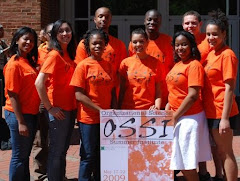
by Kate Frear Members of the UNC Charlotte’s Organizational Science doctoral program have long discussed the issue of diversity in the field. And in May 2009, those early conversations culminated in the Organizational Science Summer Institute (OSSI), a week-long program designed to give undergraduates from historically underrepresented groups an insider’s view into organizational science education and research.
“It was an exciting and exhausting week,” said Dr. Shawn Long, Organizational Science faculty member and OSSI coordinator. “On all accounts, it was a very successful and well-received initiative.”
The crux of the issue is that certain minority groups are underrepresented in graduate programs and professions within the organizational sciences. Rather than tackle the problem with recruitment and selection strategies, OSSI leaders decided to go a step further and target the pipeline itself. Specifically, that meant focusing on undergraduate students. “It’s a cutting edge approach to promoting diversity,” said Dr. Steven Rogelberg.
To that end, the OSSI leadership team invited ten undergraduate students from underrepresented groups to participate in the inaugural OSSI. Because of sponsorship by Development Dimensions International Inc., Applied Psychological Techniques Inc., Valtera Corporation, UNC Charlotte’s Graduate School, the College of Liberal Arts and Sciences, the Belk College of Business, and the Chancellor’s Diversity Challenge Fund, program participants attended completely free of charge. The ten students, or “fellows,” were chosen based on interest in the organizational sciences and potential for graduate school success. The goal was to give these students a realistic preview of graduate school while helping them strengthen their applications. As such, the program featured daily
 interactions with Organizational Science students and faculty members, in which they learned about conducting organizational research and about strategies for applying to graduate school.
A normal day at the OSSI began at 8 a.m. with two hours of GRE preparation training, followed by workshops given by guest speakers and Organizational Science faculty members. In the afternoon, fellows had hands-on research sessions with faculty members and student mentors. Research sessions ranged from designing the method of a research project to analyzing data previously collected by one of the mentors. “I felt like I was learning all the time, whether it was GRE prep or just expanding my own research,” said OSSI fellow Erik Garcia, an undergraduate student from Colorado State University. At the end of the week, fellows gave formal presentations of their research sessions.
OSSI was a program-wide event developed and coordinated Long as well as Organizational Science students Adrian Goh, April Spivack, Kate Frear, and David Askay. Nearly everyone else in the Organizational Science community contributed too, whether it was in the form of mentoring students, facilitating workshops, or networking at one of the community meals. “It was a pleasure working with these young folks,” said Dr. Linda Shanock. “Shawn [Long] and the OSSI team did a great job making this a great experience for them.”
For all who participated, the OSSI was an enjoyable, rewarding experience. “The Institute was great,” said OSSI fellow Brandon Crosby, an undergraduate student from Morehouse College. “I learned more than I could have ever hoped for.” Garcia added, “OSSI this summer was one of those experiences where I felt like I really gained a new perspective. It was an awesome experience!”

Given the success of this year’s OSSI, the program has a promising future. “The Institute is truly amazing and should continue for many years to come,” said Rogelberg, “On a personal level, I truly felt honored to be one of the mentors. It was a wonderful experience.”
Read more...
The Director’s Corner
by Dr. Steven Rogelberg First, let me welcome readers to the inaugural issue of The Organizational Scientist. This informative and dynamic forum will be a great way to stay abreast of key program events and news.
Second, I would like to welcome our newest cohort of doctoral students to the Organizational Science program. We are thrilled to have you here. As reported in this newsletter, these are exciting times in the program for many reasons.
Third, as we move into our fifth year of existence since being approved by the State of North Carolina, I want to take a moment and give thanks. I want to thank our terrific set of 13 engaged core faculty, your efforts and dedication make this program possible. I want to thank the Dean of Liberal Arts and Sciences (Dean Nancy Gutierrez) and the Dean of the Belk College of Business (Dean Joseph Mazzola) for their continual dedication to nurturing and supporting the program. I would like to thank all of our financial sponsors both internal and external to the program who continue, despite the economy, to generously support us as they believe in the importance of our interdisciplinary mission to meaningfully understand and work to improve employee and organizational health, well-being, and effectiveness. I want to thank our diverse set of research partners from Bank of America, to the Center for Creative Leadership, to TIAA-CREF, to the Charlotte Fire Department, to the Humane Society of the United States.
Finally, I want to thank our students. I truly could not imagine a better set of individuals. Your intelligence, motivation, energy, engagement, ethical fiber, thirst to grow, and passion for the program leaves me in awe.
Enjoy!
Read more...
Program Welcomes New Students
by Daniel BonillaAlthough several of the incoming first-year Organizational Science students hail from Charlotte, they are remarkably diverse in terms of previous work experience and educational backgrounds. They share a love of travel, with Switzerland and Aruba being among their recent vacation spots. They’re also all looking forward with great anticipation to starting their doctoral education. The faculty and students of the Organizational Science doctoral program extend to them a warm welcome. Below are some basic facts about each student.
 Name: Greg Berka
Hometown: Berka grew up in Queens, N.Y. and has lived in Charlotte, N.C., for the past nine years.
Prior education and experience: Berka attended Bucknell University for his undergraduate education and earned his MBA at UNC Charlotte.
Research interests: Berka’s interests include work motivation and group dynamics. He also has an interest in workplace conflict. “From my experience there seems to be an avoidance of problems that just grow,” Berka said. “[There is] no resolution, either you go to HR and ‘tell on someone’ or it goes unanswered.”
GA assignments 2009-2010: His GA assignments are with Dr. Doug Pugh in the Management department and Dr. Cliff Scott in the Communication Studies department.
Other: Berka really likes to play sports. He is on a few softball teams, plays tennis, racquetball, wiffle ball, bowling, and basketball. He has also run a 10K and a half marathon in the past. “I really enjoy intramural sports because they are both competitive and social,” he said.
 Name: Erika Carello
Hometown: Carello hails from Greensboro, N.C.
Prior education and experience: Carello completed her undergraduate and graduate education at Wake Forest University where she received both bachelor’s and master’s degrees in psychology.
Research interests: Carello’s interests include a variety of topics, and she’s open to new areas of study. She is most interested in leadership theory and training and development. “I’m really open to anything else out there,” she said. “I know I will find something totally out of left field and say, ‘that’s it!’”
GA assignments 2009-2010: Her GA assignments are with Dr. Steven Rogelberg conducting research and being a teaching assistant for an industrial/organizational psychology class in the spring of 2010.
Other: Carello is excited about all the outdoor opportunities in Charlotte and looks forward to getting out of the office on occasion. “I like to hike … mostly with a light-weight pack and I’m really excited about the mountains,” said Carello. Her cat, Sasha, has accompanied her to Charlotte.
 Name: Sharon Doerer
Hometown: Doerer is from Charlotte, N.C.
Prior education and experience: Doerer earned her bachelor’s and master’s degree in sociology from UNC Charlotte. She has also spent many years working at Bank of America.
Research interests: Doerer is interested in groups and status differences and how those differences affect organizational outcomes. "I expect to become more acclimated to Organizational Science as a discipline, and learn how the different disciplinary perspectives advance organizational knowledge.” says Doerer. She recently attended the American Sociological Association Conference in San Francisco where she presented her thesis research.
GA assignments 2009-2010: Doerer will conduct research with Dr. Shawn Long and will work in Information Technology at UNC Charlotte.
Other: Doerer has two children—Jonathan, 10, and Emily, 8. “Some mornings I get up at 4:30 or 5 a.m. to do my writing when the house is still quiet,” says Doerer. “Finding quiet time is not as difficult when the kids are at school.” Doerer, her husband, Brian, and their children recently went to Oak Island, N.C. for vacation.
 Name: Logan Justice
Hometown: St. Louis, Mo.
Prior education and experience: Justice went to Saint Louis University and received her bachelor’s degree in psychology. She was also a research assistant in a psychology lab.
Research interests: Justice’s interests include expatriation, globalization of business, and the effects of moving on employee well-being. She is also interested in work-life balance, stress, and the benefits of perceived organizational support.
GA assignments 2009-2010: Her GA assignments include working at the Graduate College and researching with Dr. David Gilmore.
Other: Justice loves to travel and went to Switzerland this summer. “I’m big on the outdoors and what better way to experience them than among the Alps,” she said. She also just finished a half marathon in St. Louis and finished 54th out of 2,000 women.
Read more...
Faculty Spotlight: Dr. Lisa Rashotte
by Marisa Adelman To misinformed outsiders, professors may sometimes seem about as well-rounded as a cardboard box. Well, they haven’t met Dr. Lisa Rashotte. With an eclectic background and interests—including undergraduate degrees in sociology and classical civilizations, professional experiences in the non-profit sector, and personal experiences as a wife, mother, and doula—she is truly an interdisciplinary scholar who lives up to that title.
Rashotte started her educational career at Florida State University, where she majored in sociology and classical civilizations and minored in psychology and communication. When she wasn’t in classes, Rashotte worked full time for a non-profit foundation that raised funds to build and staff affordable, co-op-style student housing for students in need. Four to five hours of sleep per night were the norm, she recalled, while pursuing these interests and goals. Regardless, Rashotte still managed to complete her undergraduate degrees in only four years.
The University of Arizona was Rashotte’s next home, where she pursued her Ph.D. in sociology. The study of sociology complemented her interest in social psychology while addressing the way in which societal and organizational structures constrain human action and behavior. Compared to the rigorous undergraduate schedule she maintained, graduate school seemed a breeze. This was particularly true after she received a prestigious National Science Foundation fellowship, which provided funding and flexibility (including opportunities to minor in anthropology and volunteer with Habitat for Humanity) during her second, third, and fourth years of graduate school.
From early in her graduate career, Rashotte’s advisor, Dr. Lynn Smith-Lovin, treated her as a colleague. “She trusted me to be in charge of research projects, sending the message that I was capable of being an equal in the research process,” Rashotte said. This gave her confidence in her research and teaching abilities, and prepared her for some “particularly traumatic” hounding by one of her committee members during her final oral examination.
Like most graduate students, Rashotte faced challenges in graduate school. But she found a fundamental enjoyment in being part of the scientific enterprise and found herself attracted to “the core idea of building knowledge.” Her favorite part of the research process was—and continues to be—the design of a study. “There’s an elegance to it,” she said. Revising manuscripts, on the other hand, is by far her least favorite part.
Rashotte only applied to academic jobs out of graduate school, and her first interview was with UNC Charlotte’s sociology department. “The department seemed non-political and collegial,” Rashotte said. “The interview really gave me the sense that this would be a good place to work; plus, they were building a group-processes lab.” So within just a few days, she cancelled her remaining interviews and accepted the job.
UNC Charlotte turned out to be a great home for Rashotte. She has excelled in her teaching and research, and she’s currently serving as the chair of the Sociology Department. Given her interdisciplinary background and interests, Rashotte’s association with the Organizational Science program was a natural fit. Her current research examines social interaction in groups and teams in a variety of ways. Specifically, Rashotte said, “I am interested in how people use various kinds of information—for example, personal characteristics—to decide who is competent, which leads to future influence.” Next on her agenda is investigating the role that nonverbal behaviors play in this process.
Rashotte is also passionate about teaching. She continually seeks to bring sociology to life in the classroom and to fascinate undergraduate and graduate students alike with social-psychological experiments. “I see myself like a gardener,” Rashotte said, “trying to encourage others to learn and grow—giving them the start on a long process of learning.”
Additionally, Rashotte spends time cultivating learning and growth at home with her husband and her 12-year-old son, Tucker—for whom social psychological lessons are a part of everyday life (whether he is aware of them or not). She also serves as a doula, a role that she describes as “an assistant, coach, and mother’s advocate during the birthing process.” She’s a voracious reader, making her way through about one novel per week on top of her academic reading, and enjoys watching television and working out.
With a hectic schedule and many competing roles, Rashotte finds inspiration in her desire to make the world a better place. “This is awfully Hallmark,” she said, “but I feel a need to understand the social world simply because so many people in so many situations are not being allowed to make things better.” Her message to those of us studying organizations? Bettering people and making money are not opposites. On the contrary, “places could make more money if they paid attention to good ideas instead of ideas that come from someone who looks like they should have good ideas.” For Rashotte, a woman whose ideas have greatly influenced the interdisciplinary landscape, the call to simultaneously better people and organizations is one that she hopes will resonate in the ears of interdisciplinary scholars and practitioners alike.
Favorite Novels: Cabinet of Curiosities by Douglas Preston and Lincoln Child; anything by Dennis Lehane
Favorite TV Shows: Law and Order: Criminal Intent, Gray’s Anatomy, Survivor, and, as much as she hates to admit it, Big Brother
Favorite Sayings: “Into each life some rain must fall” – something her father used to say to her, and now she says to her son Tucker. She also enjoys many fun quotes and sayings, and starts every Introduction to Sociology class with one. For example, “if the English language made any sense, then lackadaisical would have to do with a shortage of flowers.”
Surprising Fact: She has a tattoo of the moon, stars, and clouds on her hip, which she designed herself during her time in Tucson, Ariz.
Superpower: Flying! She dreams of flying all the time.
Advice for those starting their research career: “Always be on the lookout for interesting questions.”
Read more...
Time Flies When You’re Working Hard: Rising Second-Year Students Reflect on Progress
by Ashley Andrew In the academic world, the month of August is a stepping stone of sorts. And while incoming students are getting ready to take their first steps on their Organizational Science doctoral program journeys, the rising second-year students—comprising—David Askay, Daniel Bonilla, Kate Frear, Tonya Frevert, Samantha Paustian-Underdahl and Izabela Szymanska—are eagerly joining the ranks of the more-seasoned doctoral students. Paustian-Underdahl summed up the general feeling, “While it was a lot of work, now that it’s over, I feel like it flew by.”
Though everyone agreed that the workload was much more demanding than they had anticipated, the group seemed to look back gratefully. “I feel a lot more confident after getting through the first year,” said Bonilla. “I was convinced in the fall that they made a selection mistake by letting me in.” That imposter syndrome, however, seemed to fade for the group as they found their footing in the program. “I realize that a lot of knowledge stayed with me and now I feel more confident that I have all of that knowledge to draw upon,” Szymanska said.
This class is one of the most diverse to date in terms of both
 geography and research interests. Hailing from Illinois, Tennessee, Georgia, Michigan, California and even Poland, this cohort comes from range of undergraduate and graduate backgrounds including cognitive psychology, sociology, management, and psychology. Still, sitting down with them, it’s clear they have formed quite a bond throughout the year and remain supportive of one another. They even have their own cohort nickname (which they can’t reveal) and often socialize with one another outside of school.
  One of their favorite memories as a group was planning the entertainment for the Organizational Science banquet in February 2009, where they put on a skit for fellow students and faculty members. They also enjoyed cooking Chinese food together and attending various conferences. “The SIOP [Society for Industrial and Organizational Psychology] and ICA [International Communication Association] conferences were fun because it was great to see a different side of the academic world,” said Paustian-Underdahl.
Coming from out of state, the students seemed to  find the transition to Charlotte relatively easy. As Frevert pointed out, “It’s a nice diverse city with lots of different things to do.” All of them lived in Charlotte’s University City area during their first years, given its close proximity to campus—making it convenient for long days and late nights at school. On the weekends they enjoyed hanging out in the North Davidson “NODA” arts district of Charlotte and participating in the bi-weekly gallery crawl for cheap and convenient fun.
In addition to the extra workload and a new city, they encountered a few other surprises along the way. “I didn’t realize how ‘green’ I was and how much I had to learn about the other disciplines,” said Frevert. Paustian-Underdahl added that she was surprised to learn how difficult the publication process can be. “After we came to the end of the semester, I was surprised to know that survival was possible,” Szymanska joked.
 The students also commented that the support given by senior students and faculty members was a pleasant surprise. Bonilla said that it was nice to know that you could go to other students with questions and concerns while Frevert pointed out that she did not feel she was in a “cut-throat” program and enjoyed having the freedom and self-direction to choose her own projects.
Although their first years are behind them, this cohort has no intention of slowing down and continues to set high goals. Fulfilling requirements in master’s-degree programs (in which they are co-enrolled), working on publishing research, and becoming experts in their fields are some of the future endeavors for which this class is gearing up.
Ready to pass the torch, the group leaves the incoming class with the following advice:
- Relax
- Get enough sleep
- Take vitamins
- Schedule your time
- Don’t be afraid to ask questions
- Use your built-in support network
- Take some time out to live your life
- Remember that even if you think the world is going to collapse, you will live to see another day
For the rising second-year cohort, it seems, the first year was about adjusting to the rigors of doctoral education while attempting to maintain a sense of balance. And with those lessons in mind, they’ll begin their second years with an augmented sense of purpose, guided by the past but with open minds toward both future challenges and opportunities. If their first years were any indication of the future, however, time will continue to seem like it’s flying as they progress even further toward scholarly excellence.
Read more...